Alberta Windstorms and Your Yard: What to Do First
Strong Alberta winds can turn calm skies into chaos in a few minutes. A chinook rolls through, or a fast thunderstorm hits, and suddenly you hear a loud crack, the lights go out, or a big limb is lying on the lawn. It is scary, especially when you are worried about your family, your home, and your power.
In that first moment, it is easy to panic or rush outside without thinking. Our goal here is to give you a simple tree triage plan so you know who to call and in what order. Some situations are for 911, some are for your power utility, and some are for an ISA Certified Arborist team like ours at Bucks Tree Service.
The most important thing is safety. Stay calm, keep kids and pets inside, and stay well back from any damaged trees, especially if power lines are nearby. You can always replace a fence panel or a shed. You cannot replace a life.
Spotting True Emergencies: When to Call 911
Some tree problems are more than just a mess. They are an immediate danger. When that happens, your first call should be 911 so first responders can secure the area before anyone else goes near it.
Call 911 right away if you see:
- A tree on a vehicle with someone still inside
- Power lines on the ground that are sparking, burning, or making noise
- A tree completely blocking the only way in or out of your home
- A large branch punched through a roof while people are inside the building
In Alberta, we often see big spruce or poplar trees dropped across main roads after a summer storm. Sometimes a power pole is snapped, with wires hanging low across traffic or driveways. These are not “wait and see” problems. They are emergency situations.
If you are unsure but you feel unsafe, treat it as an emergency. It is always better to have firefighters or police tell you it is OK than to guess on your own. Neither homeowners nor tree companies should touch trees that are tangled with live, fallen, or sparking lines. First responders and the utility must confirm it is safe before any emergency tree removal starts.
Power Lines and Trees: When Your Utility Goes First
Wind and trees and electricity are a bad mix. Even if there are no sparks, anything to do with power lines needs special care and the right order of response.
Common storm problems with trees and lines include:
- Branches resting on the service line to your house
- Limbs sagging onto street lines along your block
- A tree now leaning toward wires after the wind shifted it
- A broken top lodged in the lines above the road
In Alberta, the power company is responsible for public safety around the main lines and for restoring power. They often must attend before any arborist can start emergency tree removal near wires. That might mean they shut off power to a section, trim around the damage, or confirm the lines are dead.
As a simple rule, if a tree or branch is touching or very close to any power line, call the utility before anyone works on the tree. Watch for warning signs like:
- Buzzing, humming, or arcing sounds around branches and lines
- Trees or branches that look like they are smoking
- Metal fences or railings that are also touching branches and lines
- Wet ground near fallen wires, especially after heavy rain or hail
Never try to move branches off lines yourself, even if the power “seems” off or your lights are already out. Electricity can back-feed and can travel through wet wood, the ground, and metal. Let the utility do their part first, then an ISA Certified Arborist can step in once the site is safe.
Blocked Drives, Broken Limbs: When to Call an Arborist
Not every storm problem is a 911 call. Many are still urgent, but they are best handled by a trained arborist rather than emergency crews or DIY work.
Good examples of when an arborist should be your first call:
- A tree blocking your driveway, but not the public road
- Broken limbs hanging over your deck, garage, or kids’ play area
- A spruce or poplar that is now leaning toward the house or neighbour
- A trunk that is split partway down, even if the tree is still upright
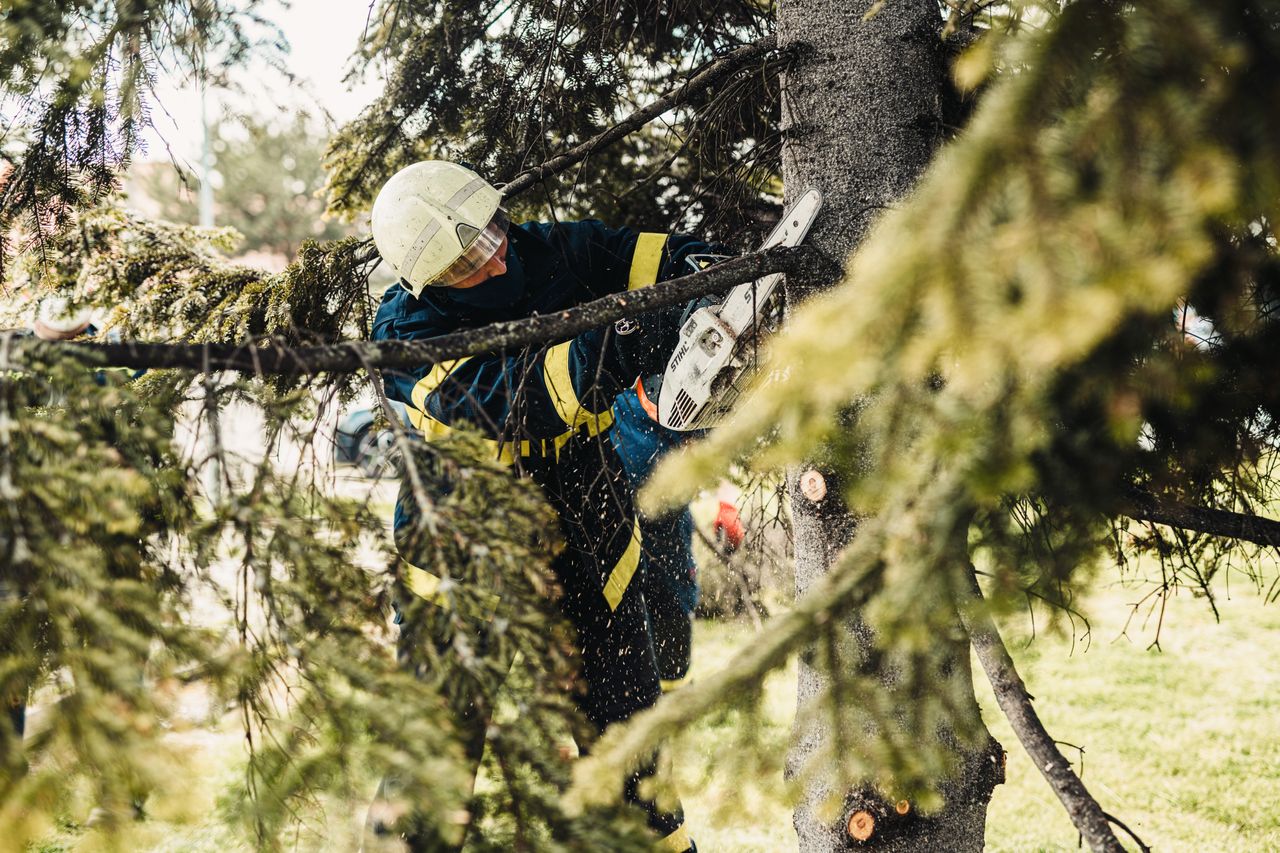
Emergency tree removal is different from regular pruning. Trees may be under heavy tension, the ground can be slick, and structures, fences, or vehicles are often right in the drop zone. Working in the dark or in bad weather makes it even harder and riskier.
DIY cutting in these situations can go wrong very fast. Hidden tension can cause a trunk to snap or twist when the saw bites in. Heavy limbs can roll, bounce, or slide off a roof. Chainsaws can kick back if the wood pinches. One wrong cut can turn a small clean-up into serious property damage or injury.
At Bucks Tree Service, our ISA Certified Arborists assess the stability of the tree, set up proper rigging, and use the right equipment to bring wood down in controlled pieces. Even partial failures, like a big hanging branch or a cracked union where two stems meet, can be urgent. The next strong Alberta gust can finish the job and drop that branch on a roof, vehicle, or neighbour’s yard if it is not handled quickly.
After the Storm: Assessing Tree Damage Safely
Once the storm has fully passed and it is daylight, you can do a basic check of your yard from a safe distance. The goal is not to fix anything yourself, but to see what needs attention and to share clear details with your arborist and your insurance company.
Walk slowly and stay well back from damaged trees. Look for:
- Broken tops or “spears” lodged high in the canopy
- Large hanging branches that are caught on other limbs
- Fresh cracks in trunks or major limbs
- Trees that are suddenly leaning or tilted
In Alberta yards, some red flag signs include fresh cracks at the base of poplars, split crotches in ornamental trees, and lifted roots or mounded soil on one side of a spruce. These can mean the whole tree is unstable, even if it has not fallen yet.
Take photos from several angles, both wide and close-up. This helps your arborist understand what is going on and decide what needs emergency tree removal and what can be booked as regular work. It also gives your insurance adjuster a clear record of what happened.
Keep in mind, a tree can look mostly fine on the outside but still have internal damage from twisting wind. An ISA Certified Arborist can tell if it can be pruned and supported or if removal is the safest choice for your family and property. Clean-up tasks like chipping, hauling, and stump grinding are also best left to trained crews, especially when wood is twisted, lodged, or under load.
Build Your Windstorm Game Plan with Bucks Tree Service
Wind will always be part of life in Alberta, but you can be ready for it. A simple storm plan takes a lot of stress out of the next big blow. Keep key phone numbers handy for 911, your local power utility, your insurance provider, and a trusted emergency tree removal company.
The other smart step is to take care of risk before the wind hits. A preventative tree health and risk assessment can uncover weak limbs, decay, or poor structure that make a tree more likely to fail. Catching problems early often means less damage, fewer emergency calls, and a safer yard.
As ISA Certified Arborists serving Edmonton and nearby communities, we know storm damage can be confusing. You do not have to figure it all out alone in the dark or during a power outage. When something happens, the basic order is simple: if it is life-threatening, call 911; if it involves power lines, call the utility; and when it is about damaged or dangerous trees, call an arborist team like Bucks Tree Service to make things safe again.
Get Started With Your Project Today
If you are facing storm damage or a hazardous tree, we can respond quickly to keep your property safe. Learn more about our emergency tree removal services and how Bucks Tree Service can handle your situation safely and efficiently. Reach out today through our contact page so we can assess the risk and schedule prompt help.